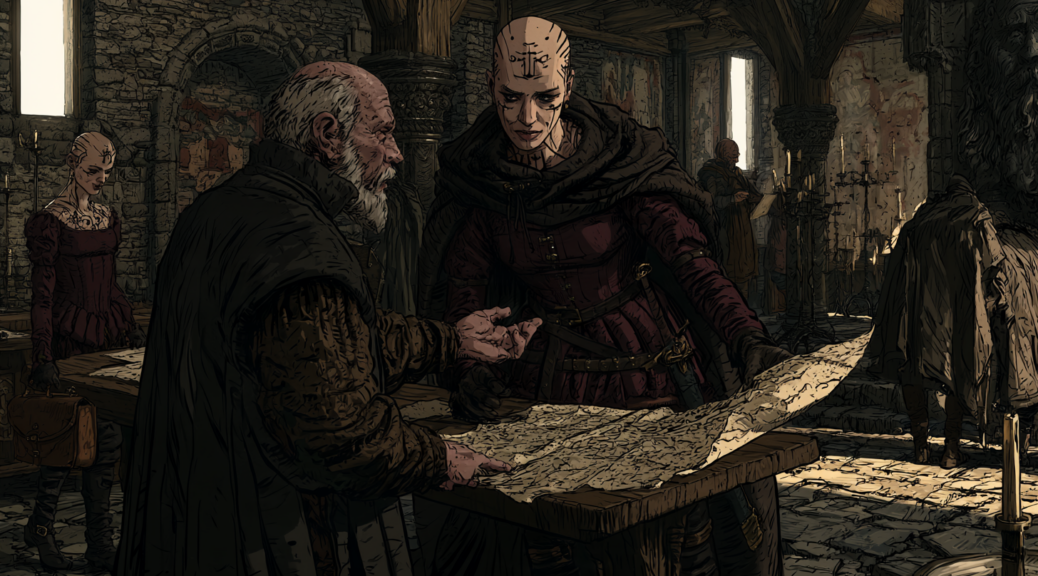
Varath Kal: The Order Behind the Daughters
I’ve been revisiting the Daughters of Demorax while working through The Ash Cartographer, partly because Alena keeps putting me in situations where I need to know what her authority actually amounts to. It’s easy enough to say that she belongs to an ancient religious order. It’s less useful when she’s standing in front of somebody who has no particular intention of doing what she asks.
That led me back to the institution itself. The Daughters have been part of Alkainos for a long time, but I’d been treating them rather too much as though they were the whole organisation. I’ve now settled on Varath Kal, a High Vala name meaning the Eternal Vigil, for the wider order. The Daughters of Demorax, or Demorathi, are a particular calling within it, distinguished by their Sight: an ability to perceive aspects of the Veil and supernatural disturbances that most people would miss. They’re investigators and hunters, not simply religious figures who happen to turn up when somebody dies. Nor are they helpless observers who need somebody else to do the dangerous work.
The wider Order has other ways of dealing with threats, including martial and magical capabilities, although I haven’t decided precisely how those people are organised. I rather like leaving that open. If I start assigning every member to a formal branch, complete with ranks and insignia, I’ll probably end up with a tidy chart that tells me very little about what it feels like to meet one of them. For the moment, I know what the organisation is for and why the Daughters have a distinctive place in it. That’s enough to write the people who belong to it.
The Varath Kal came out of a period when supernatural dangers were serious enough to demand a sustained response. Ordinary political borders were a poor fit for threats that didn’t respect them, so the hunters acquired exceptional authority to investigate and act across jurisdictions. Much later, some of those old privileges still exist, at least on paper. Whether a modern magistrate, noble or church official chooses to recognise them is another question. A Daughter might have a perfectly respectable historical claim to enter a place or demand an answer, and still find herself arguing with someone who regards the entire Order as an embarrassing relic.
I’m interested in that awkward middle ground. I don’t want the Varath Kal to be a swaggering institution that can silence every official by announcing its name, but neither do I want it reduced to a handful of ineffectual people living off a glorious past. Its purpose was never supposed to be winning disputes over precedence. A sensible hunter might decide that an argument with a magistrate is not worth having, particularly if there is a more important problem waiting beyond the town walls. Equally, old institutions can be wrong, and ancient privileges aren’t automatically justified just because they were granted during a crisis.
There is a nice tension here for the period in which The Ash Cartographer takes place. Most people have more immediate concerns than the Veil, and a great deal of the Order’s history belongs to events well beyond living memory. Yet disturbances are becoming harder to dismiss. I can explore what that means through Alena without having her deliver lectures about the institution she serves, and without making her the model for every other Daughter. She has her own judgement, limitations and history; another Demorathi might handle the same encounter very differently.
I still haven’t fixed the Order’s founding date, headquarters or full internal structure. Those details may become important later, particularly if I write stories set closer to its origins. For now, the name, its purpose and its uneasy relationship with the present give me something useful to work with whenever a Daughter walks into a room and expects to be heard.