When a Scene Works on Paper but Not in the Room
 This week I have spent a surprising amount of time making people behave more normally while impossible things happen around them.
That sounds like a small problem. It has turned out to be one of the more useful lessons from drafting the first Alkainos novel.
An outline can tell me that a supernatural disturbance grows, that somebody is in danger, that another character has to get them out, and that the scene changes what the group understands. All of that can be structurally correct. Then I write the scene and discover that a person asks a question no one would ask, explains something they would already know, waits when they would move, or responds to a frightening sight as though they are helping me demonstrate the rules of the world.
The plot works. The room does not.
The problem with useful dialogue
I have been finding this most often in dialogue. There is a temptation, particularly in supernatural investigation, to make every exchange earn its place by delivering information. Someone sees something strange; another character asks the precise question required to establish what it is; the answer advances the investigation.
Efficient, certainly. Human, not always.
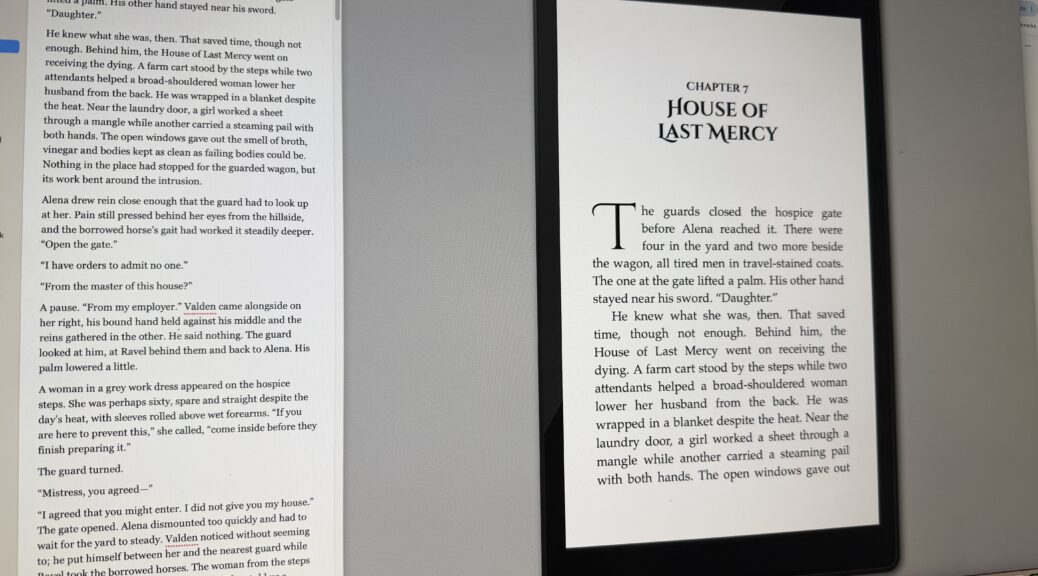
One chapter takes place in a hospice while the boundary between the ordinary world and something beyond it begins to fail. Familiar rooms appear where they should not be. Memories acquire physical edges. People who are already close to death become points around which the disturbance gathers.
The scene has quite a lot to accomplish, but the revisions that improved it were often the ones that removed cleverness. A frightened or confused person did not need to supply a neat piece of backstory on demand. Someone carrying a patient down a dangerous staircase did not need an elaborate instruction when a short warning would do. A character who already understood the urgency did not need to explain it aloud for the reader.
The supernatural material actually became stronger when the people stopped behaving as though they were there to interpret it.
Physical behaviour is part of the logic
The same applies to movement.
In an outline, “they evacuate the hospice” is an action. In prose it becomes a collection of awkward bodies: somebody has to take the shoulders, somebody else the legs, an injured hand hits a door frame, an attendant hangs back because a patient bites, a doorway that ought to lead into a dry garden suddenly appears to open into a remembered kitchen.
Those details are not decoration. They are where the supernatural event becomes credible.
If the ordinary actions underneath a scene feel solid, I can ask the reader to accept much stranger things on top of them. If the ordinary actions feel staged, no amount of carefully designed lore will rescue the scene.
That has also changed the way I am thinking about character description. I had deliberately avoided stopping the opening chapter to introduce the three principal characters with blocks of description. The result went too far the other way: I could see them because I already knew them, but a new reader had been given very little to hold onto.
The fix was not a paragraph describing each person. It was a few physical anchors placed where another character would naturally notice them: age, scars, posture, an accent, the way strangers react to someone’s appearance. Enough to put bodies into the scene without pausing it.
From outline logic to human logic
This is probably the distinction I have been learning this week.
Outline logic asks whether a scene performs its function. Does the danger increase? Is something discovered? Does a relationship change? Does the chapter leave the story somewhere different from where it began?
Human logic asks a different set of questions. Why is this person still standing here? Why would they say that now? Would they really explain this? What are their hands doing? What does the frightened attendant care about while the investigator is thinking about the larger mystery?
I need both.
This is related to the “clever but flat” problem I wrote about recently, but it feels like the next stage of it. Making clues consequential gets the story moving. Making people react like people makes the movement believable.
The useful test has become very simple: ignore what I need the scene to achieve for a moment and imagine standing in the room.
If the behaviour stops making sense, the scene is not finished.