The Road Should Lead Where It Always
One of the more useful decisions I’ve made about Alkainos is that most of it ought to feel like somewhere a person could actually live.
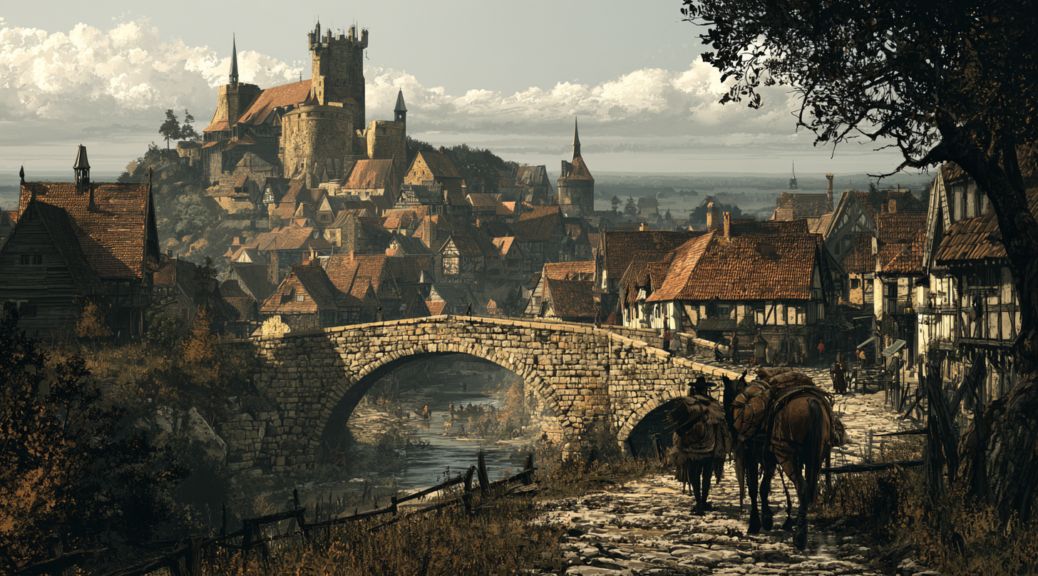
A traveller can cross a bridge, pay a toll, argue about the price of a room and find somebody willing to mend a broken harness. Towns have trades, officials, religious obligations and people who would rather finish their day’s work than become involved in somebody else’s trouble. The world is broadly familiar, even if its history and beliefs are not our own.
That ordinary life matters particularly when the supernatural intrudes. If every street is sinister and every stranger speaks in riddles, there is very little left for a disturbance to unsettle.
The first wrong thing
In the first Alkainos novel, I’ve been drawn towards a fairly intimate kind of horror. A place looks as it should until a familiar detail refuses to behave. A distance no longer makes sense. A room seems to belong somewhere else. Something that ought to be safely beyond reach feels suddenly close.
I like the moment before anyone can confidently say what has happened. A person can explain away a strange noise or a mistaken turn. It’s harder when the explanation requires them to distrust their own memory of a place they’ve known for years.
Alena, as a Daughter of Demorax, has the training and Sight to recognise disturbances in the Veil that other people might miss. But I don’t want her presence to make the unknown comfortable. Knowing that something is wrong doesn’t automatically tell her how far it extends, who is in danger or what can be done about it. Her companions still have to deal with doors, horses, frightened witnesses and the practical consequences of whatever she discovers.
The more convincing those ordinary details are, the less explanation the strange ones need.
Changing the kind of fear
Thinking beyond the first book has made me consider how a trilogy can become more unsettling without simply making each new threat larger. Three books full of increasingly spectacular disturbances would be easy to plan and, I suspect, rather tiring to read.
The broad direction I’m exploring is a change in the nature of the fear. The opening story is concerned with the uncanny: the familiar world becoming unreliable in small, deeply personal ways. Later stories can bring more of Alkainos’s accumulated history into view, so that places and institutions carry the weight of things that happened long before the present characters arrived. Eventually the danger needs to feel more immediate and more difficult to keep at a distance.
Those are differences in atmosphere rather than promises of particular events. Each novel still needs its own investigation, its own people and a conclusion that matters. I don’t want a reader to reach the end of a book and discover that it was merely an elaborate introduction to the next one.
There is also a limit to how much of the world’s underlying machinery I want to explain. Alkainos has a cosmology, and I’ve been developing it in considerably more detail than the novels are likely to need on the page. That work helps me keep the strange things consistent. It doesn’t mean every character should understand them, or that every mystery becomes better once its mechanism has been described.
Something to come back to
The part I keep returning to is the contrast. I want the roads to remain useful roads, the towns to remain inhabited towns and the people to have concerns beyond the Veil. A place can offer shelter, a decent meal or an interesting conversation. It can also hold something nobody quite understands.
For the unsettling moments to matter, there has to be a world worth returning to afterwards.
And when a traveller sets out the following morning, the road should still look as though it leads exactly where it always did.