Not Every Alkainos Story Needs to Change the World
One of the temptations of building a fantasy world is to keep finding reasons for the whole thing to be in danger.
Alkainos has ancient powers, competing nations, an uneasy boundary between worlds and more history than any single novel could reasonably use. There is plenty of material there for stories with enormous consequences. But while thinking about the books that might follow the first trilogy, I’ve been coming back to a simpler question: does every adventure need to change the world?
I don’t think it should.
A story can have a small map
The first novel takes place against a much larger background, but its immediate concerns are local. The people caught up in its events have urgent problems of their own. They cannot see the whole history of Alkainos, and they certainly cannot stop to explain it to the reader. They need to work out what is happening, whom they can trust and what to do next.
That is a useful scale for a story. A town can matter without being the capital of a kingdom. A road can be dangerous without carrying an invading army. The fate of a handful of people can be quite enough to keep me turning pages, provided I care about them and understand what they stand to lose.
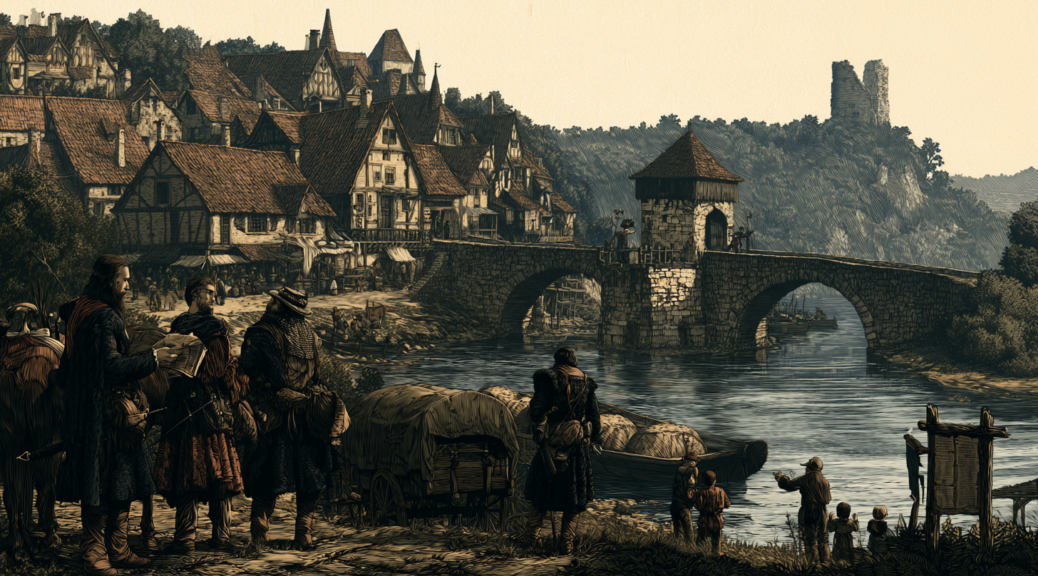
There is also something satisfying about allowing a place to remain a place after the characters have left it. A bridge is still used by merchants. An inn still needs supplies. The people who helped, hindered or simply watched the adventure unfold have lives that do not end when the protagonists ride away.
More than one kind of danger
The Veil gives Alkainos a particular kind of supernatural unease, and it is central to the stories I’m working on now. But I don’t want it to become the explanation for every strange or dangerous thing in the setting.
There are rulers, traders, thieves, soldiers and people who want something badly enough to do harm in pursuit of it. There are places such as Port Baratka where a story could begin with a ship, a disputed cargo or the promise of treasure. I also want room for monsters and other dangers that need not be connected to the Veil at all. Some of those are possibilities rather than developed stories, but that variety is part of what makes the world worth building.
A treasure hunt does not need to uncover the secret history of creation. A dangerous journey does not have to turn into a war. Sometimes the object of the adventure can simply be worth finding, or the person worth rescuing, or the trouble worth surviving.
That doesn’t mean the consequences are trivial. They can be life-changing for the characters involved. They just need not rearrange the map.
Leaving room for the larger stories
I do want to write about wider events eventually. Alkainos has nations and institutions whose decisions affect far more than one village or one travelling party. There may be stories in which the stakes really do extend across borders, or in which something long buried in the world’s history can no longer be ignored.
Those books will need more care. The larger the consequences, the more people and places a story has to account for. If every novel operates at that scale, the setting risks becoming a succession of catastrophes, with very little ordinary life left between them.
For now, I’m more interested in making individual adventures work. Even within a connected trilogy, each book ought to have a problem worth following and an ending that means something. Connections can accumulate. Characters can return. An old name or a passing reference might acquire significance later. But a reader should not have to treat one book as homework for the next.
That is the balance I’m aiming for as Alkainos grows: a world large enough to contain the great upheavals, but also large enough that most of its stories can happen without one.