A City That Doesn’t Stop for the Story
When I began working out the next Alkainos novel, one of the questions I kept returning to was what the city would be doing while the characters were busy with their own concerns.
That sounds obvious, but it’s easy to build a fictional city around the needs of a plot. The inn exists because the travellers need somewhere to sleep. The archive exists because somebody needs a document. The market provides a convenient crowd, and the tavern provides a convenient conversation. Before long, the whole place feels as though it has been waiting for the protagonists to arrive.
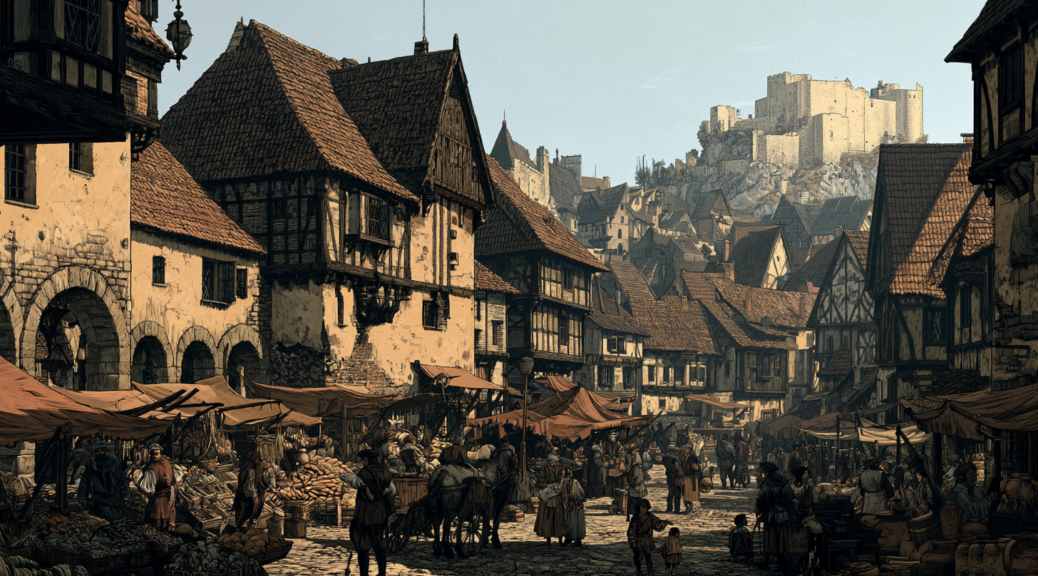
Morne needs to be more than that. It is a busy river city, with trade, travellers, established institutions and an ancient keep overlooking its streets. People have their own business to attend to, and most of them have no particular reason to care about the questions that interest Alena and her companions.
That ordinary indifference is useful. It makes the setting feel larger than the story taking place within it.
I’ve been thinking particularly about how information travels through a city. A person who spends every day in the same square may notice a change long before an official does. A porter knows which buildings receive deliveries. An innkeeper remembers faces and habits. Someone working near a passageway might know that a route has been closed, even if they have never thought to ask why.
None of these people needs to be secretly important. They need jobs, routines and reasons to pay attention to particular things. What they know should follow naturally from where they live and how they spend their days.
There’s a balance to strike here. If every conversation produces a revelation, an investigation becomes a sequence of conveniently placed answers. If nobody knows anything, it becomes an exercise in frustration. More interestingly, people can know something useful without understanding its significance. They may remember an event imperfectly, interpret it through local gossip, or simply consider it too commonplace to mention.
This also gives the characters different ways to approach the same place. An official enquiry might open doors that are closed to a stranger, while a friendly conversation over a drink may reveal details that never reach an official record. Observation, patience and a willingness to listen become as valuable as authority.
Morne’s public spaces matter for this reason. Its streets, inns and older passages are not merely routes between the dramatic locations. They are places where ordinary life continues, where rumours gather, and where the city can quietly contradict the assumptions of someone arriving from elsewhere.
I like the contrast between the enormous age of Morne’s keep and the small, practical concerns of the people living beneath it. The keep may dominate the skyline, but a shopkeeper still needs customers, a traveller still needs a bed, and somebody has to keep the streets and passages in use.
Those everyday details aren’t distractions from fantasy. They provide the scale against which its stranger events can be measured.
I don’t want to explain every street or introduce a cast of minor characters simply to demonstrate that the city is populated. Most of that work should remain behind the scenes. The aim is to know enough about Morne that, when a character turns a corner or asks a question, the answer feels as though it belongs to a place that was already there.
The story may change what happens in Morne. But for most of its inhabitants, life will carry on around it.