Making Magic Cost Something
One of the difficulties with writing fantasy is deciding what magic can do. The more useful question, I’m finding, is what it asks of the person using it.
In Alkainos, the Veil is not something that can be mastered simply by learning the correct words or acquiring a sufficiently powerful object. The Daughters of Demorax have traditions, training and techniques that allow them to perceive and sometimes engage with things beyond ordinary experience. That knowledge matters, but it doesn’t make them safe.
I’ve been working through a sequence for the second novel in which those distinctions become particularly important. I won’t describe the events themselves, but the planning has brought me back to a problem I encountered in the first book: how do you let a character do something extraordinary without making the extraordinary feel convenient?
The obvious solution is to give magic a price. Fantasy has plenty of familiar versions of that bargain: exhaustion, injury, sacrifice or the loss of something valuable. Those can work, but only if the cost is more than a fee paid after the useful part is over. If a character can perform a miracle and then spend a day in bed, the reader soon learns to treat the bed rest as an administrative detail.
What interests me more is uncertainty. A technique might work well enough to encourage someone to try it again, while leaving important questions unanswered. Greater ability may improve what a character can perceive without giving them greater control over what they find. Preparation may reduce one danger and expose another. And a person under pressure may choose to accept risks that they would have condemned in calmer circumstances.
That last possibility is particularly useful for Alena. She is educated, curious and capable, and her work as a Daughter requires her to make decisions when the available evidence is incomplete. I don’t want her to become reckless merely because the plot needs a mistake. I want her decisions to arise from recognisable strengths: a determination to understand, a refusal to abandon people and a belief that difficult problems can be solved if she looks hard enough.
Those are admirable qualities. They can also lead someone into trouble.
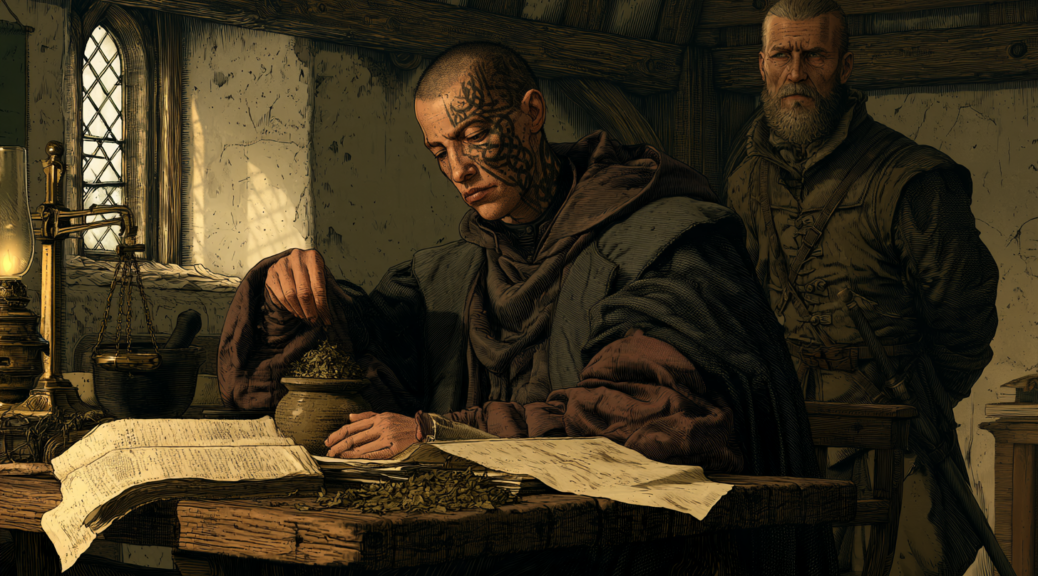
The same principle applies to the practical details of magic. I’ve been thinking about inherited preparations and methods that might sharpen a Daughter’s perception of the Veil. They should feel like the accumulated, imperfect knowledge of a working tradition, not a collection of coloured potions with predictable effects. Someone has learned how to prepare them, someone has passed that knowledge on, and someone has probably warned against taking too much. Such warnings are more interesting when they come from experience rather than from a rulebook.
None of this means that every supernatural act needs a punishment. If the reader expects an immediate penalty every time, that becomes another predictable system. Sometimes the consequence should be a difficult decision, a damaged relationship or knowledge that cannot easily be put aside. Sometimes the danger is simply that success gives a character confidence they haven’t entirely earned.
I also want the people around Alena to matter. A warning from a companion isn’t there just to tell the reader that something is dangerous. It comes from a relationship, from a different assessment of the situation, and perhaps from knowing the person making the decision better than she knows herself at that moment. Disagreement can be as important as any supernatural mechanism.
While developing the next book, I’m trying to keep those questions close to the characters rather than resolving them in an elaborate explanation of how the Veil works. The world needs consistent foundations, certainly, but the reader experiences those foundations through choices and consequences.
Magic becomes more convincing, I think, when knowing how to attempt something is not the same as knowing whether you should.