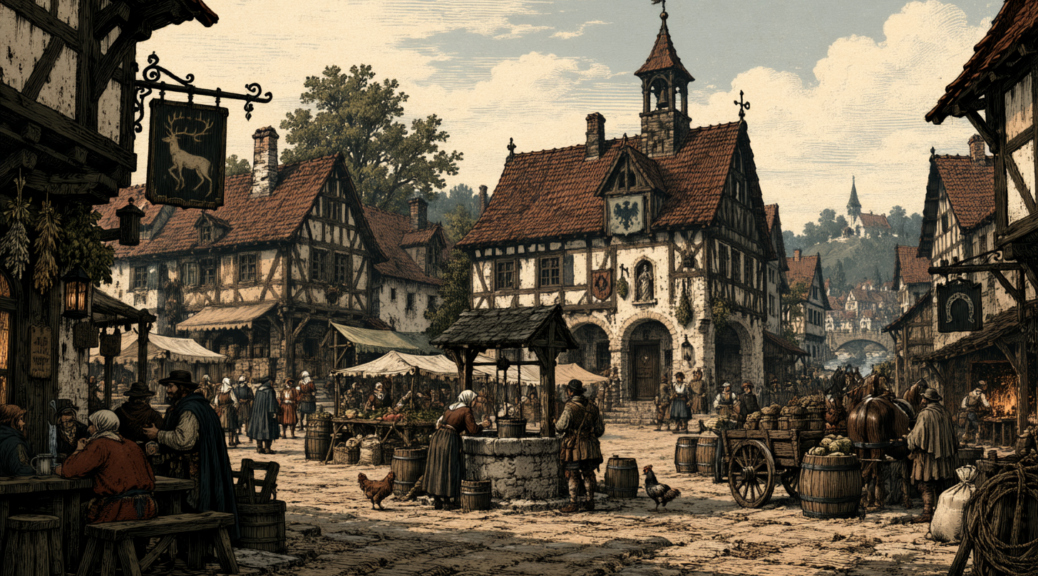
Steinbruck: The Town the Book Needed
One of the things I’m enjoying about writing The Ash Cartographer is that the book keeps forcing parts of Alkainos into existence.
Steinbruck is a good example. I didn’t begin with a grand plan for another important town. I needed somewhere on an Eidengardian road where a carriage could be stopped, where there was enough civic authority for a magistrate and watch to take over, enough stabling and trade to deal with travellers and horses, and enough local character that the place didn’t feel like a nameless stop between more important locations.
Once the story needed Steinbruck, the obvious next question was: what kind of town has grown up here?
A road town first
Steinbruck is not a major city. It is a regional road and market town, sitting just beyond a stone toll bridge on a well-used route through Eidengard. Its importance comes largely from movement.
People pass through. Carts break. Horses lose shoes. Merchants need beds, fodder, storage and information. Rural produce comes into town and goods from elsewhere move back out again. That gives Steinbruck a practical economy: farriers, wheelwrights, harness-makers, coopers, ostlers, grain merchants, wagon yards and small smithies turning out nails, buckles, hinges and whatever else keeps traffic moving.
I imagine it as a place that is busy without being wealthy. On a wet day the approaches are churned into mud. The older streets nearer the centre have patches of stone and gravel, but nobody has made them elegant. There is woodsmoke, wet wool, dung, hot iron and the steady noise of wheels and harness bells.
It should feel useful rather than picturesque.
The Grey Ox
Every road town needs somewhere that exists mainly because people are forever arriving at inconvenient times.
For Steinbruck, that is the Grey Ox: a large inn near the western market approach with a broad yard, substantial stabling and rooms that range from perfectly respectable to “there was technically a bed”. It serves carriers, drovers, merchants and anyone else travelling with animals or baggage.
The food is solid, the beer is decent and somebody is almost always awake.
The keeper is Marta Kessler, a practical widow who inherited the lease along with its debts and has spent years making the place pay. She remembers faces better than names, has no patience for unpaid tabs, and is very good at answering a question without necessarily telling you everything she knows.
That makes the Grey Ox a useful place for rumours. Information reaches it quickly. Accuracy is another matter.
The Copper Kettle
Not every inn in a road town should be full of travellers, so I wanted somewhere that belonged more to Steinbruck itself.
The Copper Kettle is a smaller eating-house and ale room on a side street off the market square. It has no substantial stable, which means more of its customers are locals: tradesmen, clerks, shopkeepers and people who have finished at the market.
Its sign is exactly what the name suggests — an old dented copper kettle hanging over the door. The building also has an iron nail driven through the lintel. Nobody currently running the place put it there, and nobody would think of taking it out.
Which leads into the stranger part of Steinbruck.
A town that remembers the Veil without quite knowing it
Steinbruck is not a haunted town, and I don’t want it to become one of those fantasy places where everybody talks knowingly about the supernatural because the plot happens to need something supernatural nearby.
Most of the time, nothing unusual happens there at all.
What Steinbruck does have is a longstanding, usually modest susceptibility to disturbances in the Veil. Over generations that has left traces in local custom rather than creating a public reputation.
Older houses may have small marks cut near a lintel, a piece of old iron built into a threshold, dried plants or knotted cord above a door. Some probably do nothing. Some may once have had a practical purpose. Most inhabitants simply know that these are things older houses have.
There is also a local death custom: after somebody dies, a window or exterior door is opened briefly so that the departing soul has a clear way out before the room is closed again.
Some people presumably believe that literally. Others probably think it is nonsense and still open the window because their mother did, and her mother did, and there is no good reason to be the person who stops.
That is much closer to the atmosphere I want than overt “magic town” worldbuilding. The supernatural has shaped behaviour without necessarily explaining itself.
Brunner’s Yard
Another place I’ve added while developing the town is Brunner’s Yard, a wheelwright and wagon-repair business close to the commercial stables.
Jakob Brunner and his men can replace a broken spoke, straighten ironwork, patch a cart bed or improvise something that will survive another twenty miles of road. Brunner himself is broad-handed, slow-speaking and almost impossible to hurry. His prices are fair right up until somebody insists that an impossible repair absolutely has to be finished before dawn.
Then the price becomes educational.
Provincial, not incompetent
One thing that mattered for the novel was that Steinbruck’s civic authorities should feel credible.
The town has a magistrate, a watch and enough clerical machinery to take statements, record property, hold prisoners, send riders and pass serious matters upwards to regional authorities. The watch is mostly used to market disputes, theft, drunkenness, damaged carts and missing animals rather than conspiracies involving the Veil.
But that doesn’t mean they become idiots when something unusual happens.
I like that distinction. Steinbruck is provincial. It is not backward. Its officials know what their jobs are even when the situation exceeds their experience.
Its overall feel
The version of Steinbruck now forming in my head is somewhere between market town, transport hub and slightly rain-worn provincial administrative centre.
The market square is busiest early. By late afternoon much of the serious trade has moved into yards, sheds and counting rooms. Wagons are being repaired behind walls. Ostlers are walking horses. Clerks are copying reports. Somebody is arguing about a damaged axle. Somebody else is looking for a bed.
And beneath all of that ordinary life is a faint inheritance nobody quite agrees how seriously to take: marks over doorways, iron in thresholds, stories about hearing the footsteps of somebody recently dead, and the old habit of opening a window before closing a room.
There is even a local expression I rather like: “In or out; don’t keep the road waiting.”
Most of the time it just means somebody is standing in a doorway.
Which is probably exactly how Steinbruck would prefer it.
Built because the story asked for it
This is becoming one of my favourite ways of expanding Alkainos. Steinbruck wasn’t created because I had decided the setting needed another dot on a map. It appeared because the characters needed to go somewhere, and the events of the book required that somewhere to have particular properties.
From there, the place started to acquire its own logic.
That seems healthier than trying to design every settlement in advance. The story gives me the skeleton; then I can work out what trades would exist, what people would eat, where travellers would sleep, what officials would actually do, and which bits of older belief might have survived into ordinary habits.
Steinbruck now feels like somewhere I could send characters again without having to rebuild it from scratch.