Why a Fantasy World Needs Places to Rest
Fantasy worlds are often described through their grandest places: capitals, fortresses, temples and the sites of old battles. Those are useful landmarks, but they tell us only part of how a world works.
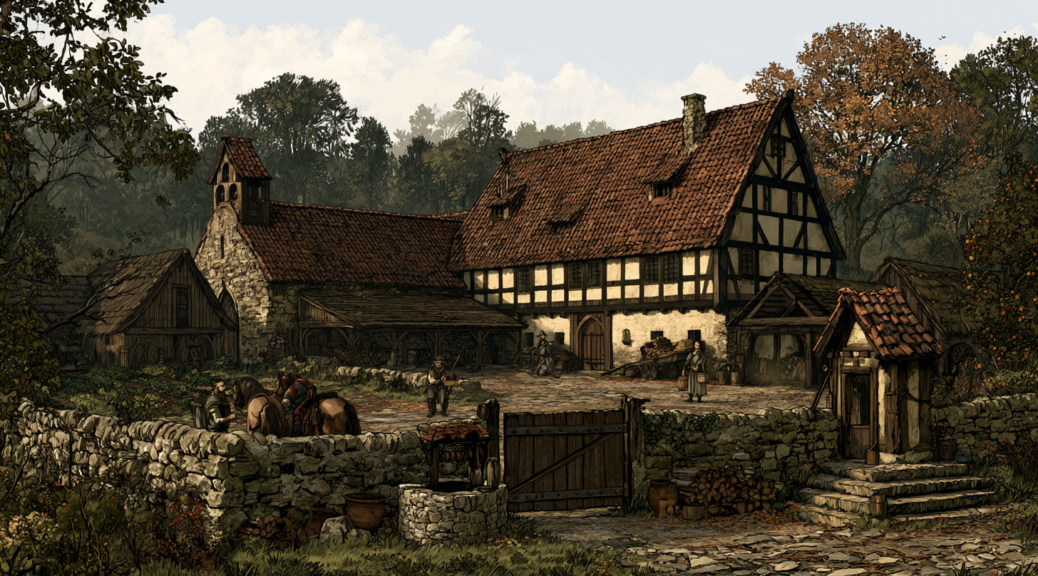
I’ve been developing a much smaller location for the next Alkainos novel: an old waystation belonging to the Order of Demorax, set among the woods of Eidengard. It isn’t intended to be spectacular. In fact, much of its value comes from being ordinary.
The property dates from a time when the Order had greater resources. There are a few stone buildings, a walled courtyard, stables, a chapel and gardens that contribute something to the kitchen. A small staff keeps the place running. It is secure and reasonably comfortable, but nobody would mistake it for a noble estate.
That distinction matters. A grand residence would tell one story about the Order. A modest property still maintained after its wealthier years tells another. The buildings have survived changes in fortune; their purpose has not entirely disappeared. Someone must still repair the gate, tend the horses, prepare meals and keep the rooms ready for travellers who may arrive without warning.
These practical questions are some of my favourite parts of worldbuilding. Who pays for the upkeep? How do messages travel between distant houses? What does a visitor find when they arrive after a long day on the road? The answers need not occupy pages of exposition. They shape what characters can reasonably do, and what a place feels like when they enter it.
The setting is an autumn one: damp leaves, mist among the trees and the chill of an enclosed courtyard, followed by the welcome of a warm interior. I like that contrast. It gives the waystation a character of its own without making it mysterious or magical.
More importantly, it gives people somewhere to be themselves.
An adventure can reveal a character through danger, but it can also conceal them behind the demands of immediate action. In a fight, there may be little time for anything except decisions and consequences. Around a table, the same people can joke, disagree, remember old acquaintances or discover that they have misjudged someone.
Those moments are not necessarily pauses in the story. They can change the way we understand the people who will face its next difficulty. A shared meal might establish trust more convincingly than a speech about loyalty. An awkward reunion can tell us that a friendship has a history beyond the pages of the novel.
I also want the people who maintain these places to matter. A housekeeper is not merely part of the furniture, and a working kitchen is not just background decoration. A traveller may hold an impressive title, but the person who knows how the house actually functions has an authority of a different sort.
That is particularly interesting for an organisation such as the Order. Its identity is expressed not only in ceremonies or official duties, but in the way its members behave towards the people who support them and the places they inherit.
There is a broader reason for spending time on places like this. If every location exists solely to deliver a clue, stage a confrontation or reveal a secret, the world can begin to feel as though it was assembled for the convenience of the plot. I want Alkainos to have rooms where nothing extraordinary has to happen, roads that people use for ordinary journeys, and buildings that would remain occupied whether the main characters visited them or not.
Of course, a quiet place can still become the starting point for something important. But it ought to be convincing before that happens.
The old waystation may never appear on a map beside the great cities of Alkainos. It doesn’t need to. Sometimes a world becomes more believable when we know where its travellers can find a bed, a meal and a familiar face.