Saint Erhardt and the Roads of Alkainos
One of the useful things about writing fiction in an unfinished world is that the story keeps finding bits of the setting I haven’t properly thought about yet. This week it was something fairly mundane: the road.
Alkainos already has gods, churches, religious orders and a fairly substantial cosmology behind it, but the part of the novel I was working on needed something much more ordinary. If you’ve been riding all day, you’re miles from the next town and you need food, water and somewhere safe to sleep, what does religion actually mean to you then? Working through that question led to Saint Erhardt and, eventually, an abbey about thirty miles east of Rodenheim.
Saint Erhardt
Erhardt belongs to the western Church and has a particularly strong tradition in Eidengard. He is remembered for sheltering travellers during a period of conflict or disorder and refusing to surrender people once he’d accepted them beneath his protection. He eventually died for it, although I’ve deliberately left much of the history vague for now. I don’t know his exact dates, precisely which conflict was involved, or how much of the later story is true. None of that is needed yet.
What I did need was the tradition that grew out of the story. Erhardt became associated with roads, travellers, hospitality, sanctuary and safe passage. That gives him a useful place in everyday life. A traveller doesn’t need to know his biography or a page of theology to understand what it means when a religious house bearing Erhardt’s name offers water at the gate.
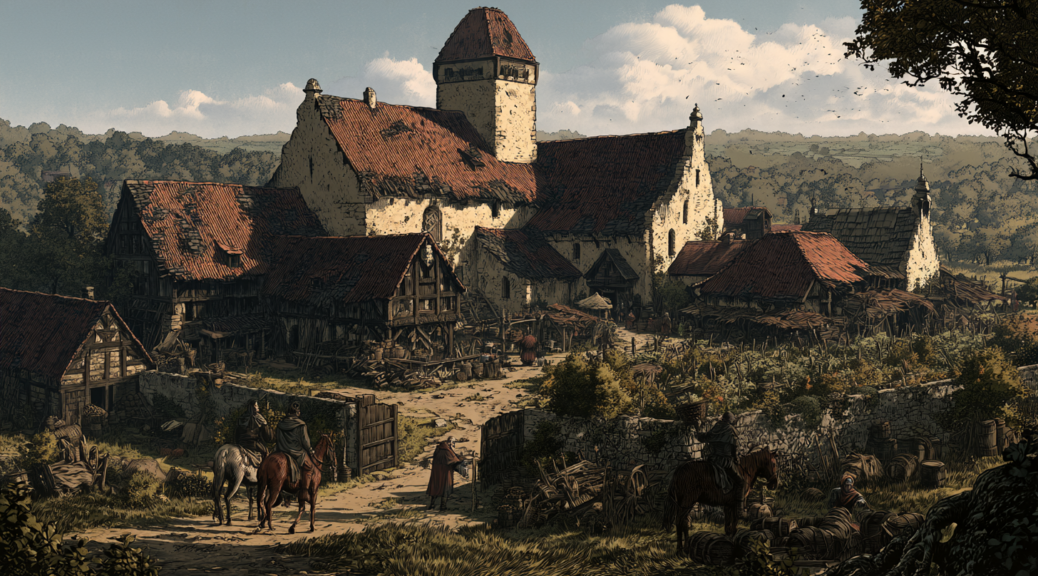
The abbey itself grew out of the same practical questions. I didn’t want another ominous fantasy monastery where everyone whispers in corridors and there is inevitably something unpleasant in the crypt. It has orchards and gardens, people carrying baskets across the court, horses being watered and a guesthouse where tired travellers can eat and sleep. Hospitality isn’t just part of the scenery; it’s one of the reasons the place is there.
That seems a more useful way of thinking about religious institutions in Alkainos generally. They can still have impressive buildings, politics, wealth and secrets, but they also need to do ordinary jobs. Historically, religious houses fed people, accommodated travellers, tended the sick, buried the dead, kept records and supported communities. Bringing some of that into Alkainos makes the Church feel less like a piece of fantasy furniture.
Where saints fit
Working on Erhardt also helped me settle a little more of how everyday religion works in the western parts of Alkainos. The setting is polytheistic, but I don’t imagine most people choosing one god and then ignoring the rest. A farmer might think about one divine aspect around the harvest, a soldier another before battle, while a family might turn to Demorax when somebody is dying. Which traditions matter most will depend on where you live and what is happening to you.
Saints fit quite comfortably into that. Erhardt isn’t another god and doesn’t need a separate religion built around him. His memory can survive in an abbey, a roadside shrine, a custom at an inn or simply in what people expect when they ask for shelter. It also gives different parts of the world room to develop their own emphasis. A port, a farming district, a garrison town and a mountain road shouldn’t all have exactly the same religious life just because they belong to the same Church.
Building only what I need
A few years ago I might have been tempted to design a list of twenty saints, complete with symbols, feast days and biographies, before deciding where any of them appeared. I’m increasingly going the other way. In this case the novel needed a religious house on a road, which meant I had to know why it was there, why it would receive strangers and what travellers would expect from it. Saint Erhardt came out of answering those questions.
There are still plenty of blanks. I haven’t fixed his iconography, his feast-day customs or the early history of the abbey, and I don’t particularly want to until I have a reason. But there is now enough behind him that if somebody in a later story passes a small shrine to Saint Erhardt, or an innkeeper invokes his name while giving shelter to someone in trouble, I’ll know why it’s there.