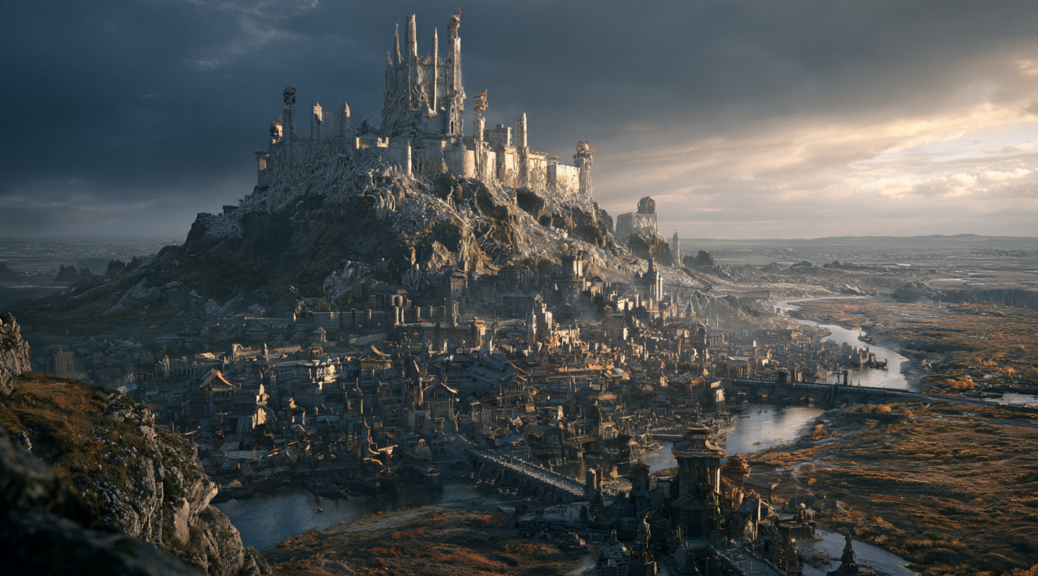
Morne: Building a City Around an Older Secret
I’ve spent quite a lot of this week working on Morne, a city that will be important in the second Alkainos novel. The name is still technically a working one, but it has survived long enough that I’m becoming attached to it.
Morne actually started by inheriting an idea from somewhere else. I had previously been developing Aquis as a possible setting for the next book, including some darker material around an old city built with human bones. The more I worked on it, though, the less convinced I was that all of those ideas belonged together. Aquis already had its own identity, and piling another major concept onto it was starting to make the place feel designed around the needs of a novel rather than like a city that existed before the story arrived.
So I separated them. Aquis gets to remain Aquis, and the bones moved inland to a new city.
A city that grew towards the hill
The basic geography of Morne is now fairly clear. It sits on a navigable river near the eastern side of Varenne, with an ancient fortified hill overlooking the crossing. What I like about it is that the fortress wasn’t necessarily the natural centre of the later city. The ordinary settlement began down by the river, where people actually wanted to trade, cross, unload boats and make a living. Over time it spread towards the hill and eventually around it.
That gives Morne two quite different shapes at once. Down below is a working river city: quays, bridges, timber buildings, warehouses and streets following the practical demands of trade. Above it is something much older and less accommodating, built in a sombre pale stone and occupying the best defensive ground. The later city has had to grow around what was already there.
I’m also planning to introduce Morne from the river. That should give the approach a nice progression: more traffic, more buildings on both banks, the first bridges and quays, and then the old citadel becoming increasingly difficult to ignore above everything else. It is a much more interesting arrival than simply putting the characters outside another city gate.
The bones in the walls
The part I’ve been enjoying most is Morne’s uncomfortable relationship with its own history.
At some point before the modern political order, a ruling dynasty occupied and enlarged the old fortress. After crushing an enemy or uprising, they incorporated the remains of the dead into new construction. The most blatant expression of that was a high tower displaying skulls out across the surrounding country. It wasn’t subtle symbolism. It was a warning.
That gives the city an obvious explanation for its reputation, and probably the explanation most people in Morne would grow up knowing. The awkward detail is that the dynasty didn’t start it. Bones were already present in the oldest parts of the fortress when they arrived.
I don’t want to explain that away too quickly. One of the things I’m trying to preserve while developing the next book is the difference between history that people in the setting understand and history they have merely fitted into a convenient story. The later rulers did something appalling and very visible, so it is easy for subsequent generations to attribute all of the bone-work to them. The older masonry suggests that Morne had secrets long before that dynasty existed.
Leaving some of it unfinished
There is still a fair amount about Morne that I haven’t fixed. Its exact political history is under discussion, as are some of its institutions and the details of how it relates to neighbouring regions. I’m resisting the temptation to fill those gaps just because they are there.
The parts I need are becoming solid: the river, the crossing, the old hill, the later city spreading around it, and the uncomfortable fact that different periods of Morne’s history have left their marks in the same place. That is enough to start making streets, neighbourhoods and individual locations feel as though they belong to the same city.
It also gives me something I didn’t quite have when the material was attached to Aquis. Morne has a reason to look the way it does. You can stand by a busy river full of ordinary trade, look up at the pale fortress above the roofs, and see several versions of the city at once.